
Friday, 31 August 2012

Wednesday, 29 August 2012
Raw Sun-Dried Tomato Marinara Sauce

This uncooked marinara sauce is made from both sun-dried and fresh cherry tomatoes, along with ample basil and olive oil. Served over a bed of zucchini “noodles,” it’s an invigorating way to get your pasta fix while eating a plate full of veggies. If raw vegetable noodles aren’t your thing, feel free to enjoy this bright, aromatic sauce with any ol’ cooked pasta.
Makes about 2 servings
INGREDIENTS
1 ½ cups cherry tomatoes, halved (use heirloom tomatoes for a multi-colored effect)
½ cup packed sun-dried tomatoes (soaked if not already soft)
1/3 cup basil leaves
3 tablespoons extra-virgin olive oil, plus more for serving
1 teaspoon dried oregano
½ teaspoon sea salt, plus more for serving
¼ teaspoon freshly ground black pepper
1 medium zucchini, for serving
1 medium yellow summer squash, for serving
METHOD
Combine cherry tomatoes, sun-dried tomatoes, basil, olive oil, oregano, salt, and pepper in a food processor. Puree until desired level of consistency is reached (may be smooth or chunky). Set aside.


To make zucchini “pasta” strands, you have a few options: You can use a commercial “Spiralizer” to make thin, spaghetti-like strands from the zucchini and squash. You may also use a vegetable peeler to shave vegetables into thin ribbons or strands (see photo below). Also, you may use a mandoline to shave very thin slices of the vegetables.


To assemble: Toss shaved zucchini with a few drizzles of olive oil and a pinch of salt in a medium bowl. Arrange on two serving plates. Top with a large dollop of prepared sauce. Serve immediately.
* Leftover raw sauce is incredible used as pizza sauce! Use it in on either a raw or traditional baked pizza for delicious results with a very bold tomato-basil flare.
Written by Kimberley Stakal
Tuesday, 28 August 2012
Community Supported Agriculture for Organic Food

Organic SquashHaving trouble buying the highest-quality seasonal organic produce? Unable to find a wide variety of natural and organic fruits and vegetables to bring home? Lack the backyard space to grow your own natural and organic foods?
If you live in an area where shopping for organic food poses a challenge, don't throw in the all-natural kitchen towel! Many Americans in similar circumstances have found the perfect solution: community supported agriculture, or "CSA." First popular in Japan and Switzerland in the 1960s, the CSA movement has -- pardon the pun -- taken root with a vengeance in the United States, where it is sometimes referred to as "subscription farming."
How, exactly, does a CSA work?
By definition, CSAs are composed of "a community of individuals who pledge support to a farm operation so that the farmland becomes, either legally or spiritually, the community's farm, with the growers and consumers providing mutual support and sharing the risks and benefits of food production," according to the U.S. Department of Agriculture.
Community members -- usually referred to as farm "shareholders" -- pledge to share the expected costs of a farm's operation, including the farmer's salary. Members can stipulate that all produce must be grown under the strict tenets of organic farming and organic gardening practices. Each individual's investment yields a share of farm crops -- not to mention a close connection to freshly picked organic produce that hasn't been sitting on grocery shelves for days or even weeks.
Perhaps CSA expert Elizabeth Henderson, author of "Sharing the Harvest: A Guide to Community-Supported Agriculture," puts it best: "Starting a community supported agriculture project is a little like having a baby -- you unleash biological and social forces that may take you in directions you never expected." As a shareholder, you demonstrate respect for the earth by taking responsibility for organic farming practices, energy-efficient production and distribution, paying local farmers a decent wage, controlling the land in your area and elevating environmental consciousness.
"Most CSAs offer a diversity of vegetables, fruits and herbs in season," the USDA notes. "Some provide a full array of farm produce, including shares in eggs, meat, milk, baked goods and even firewood. Some farms offer a single commodity or team up with others so that members receive goods on a more nearly year-round basis. Some are dedicated to serving particular community needs, such as helping to enfranchise homeless persons. Each CSA is structured to meet the needs of the participants, so many variations exist, including the level of financial commitment and active participation by the shareholders; financing, land ownership and legal form of the farm operation; and details of payment plans and food distribution systems."
Luckily, the Internet has made it easy to track down a CSA in your area. Several excellent online directories provide CSA listings:
Santa Cruz, California-based Local Harvest, a supporter of "buying local" and organic farming since 1988, has a wonderful, comprehensive online search engine. You may also search for farmers' markets, organic restaurants and food co-ops.
The Sustainable Agriculture Research and Education (SARE) Program at Utah State University in Logan has a fully searchable CSA locator, organized by state. Links to individual farms are only a mouse click away.
The Biodynamic Farming and Gardening Association, headquartered in Junction City, Oregon, also has a great guide. It specifies whether farms are conventional, organic or biodynamic (a more "cosmic" approach to farming; click here for a thorough description).
These websites also allow you to add your local CSA to their resource guide so you can publicize your community's efforts -- a move that will attract more shareholders.
For additional information on setting up or joining a CSA, visit the SARE online store, where you may purchase a wide range of books and reference guides for developing a sustainable agricultural solution in your hometown
Written by Laura Klein
Sunday, 26 August 2012
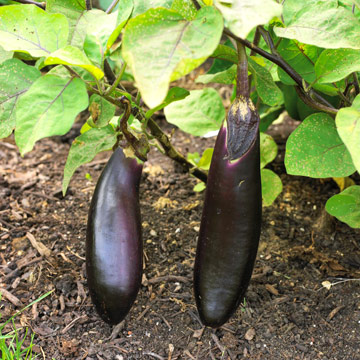
Eggplant [Solanum melongena]

Eggplant
Eggplant is not only a wonderfully international food, it's also versatile. Add it to soups and pasta dishes or use it as the basis for hearty meatless casseroles and other entrees. Vegetarians value its rich, deep flavor as an excellent substitute for meat.
Eggplant originated in India, where it is used in many dishes, such as bengan bartha. The vegetable is also the basis for Greek moussaka, French ratatouille, and Italian caponata. The elegantly shaped, often gorgeously colored, glossy fruits vary from large oval teardrop-shape to small round grape size. And the mature color can range from white to purple, pink, striped, green, or orange. The plant needs heat and humidity to grow well. Fruit fails to set at temperatures below 65 degrees Fahrenheit.
Light:
Sun
Plant Type:
Vegetable
Plant Height:
1-3 feet tall
Plant Width:
1-2 feet wide
Special Features:
Flowers
Top Varieties
'Dusky Hybrid' eggplant
is an early-maturing variety (63 days) with dark purple fruits that are 6-7 inches long.

'Ichiban' eggplant
is an Asian-type variety that produces dark purple elongated fruits 60-70 days from transplanting.
'Ping Tung Long' eggplant
is a Taiwanese variety that bears cylindrical violet-purple fruits up to 12 inches long. 62 days

'Purple Rain Hybrid' eggplant
features wine-purple skin streaked with white. The 6- to 7-inch-long fruits mature in 66 days.

'Tango Hybrid' eggplant
bears 7-inch-long white fruits in just 60 days.

'Twinkle Hybrid' eggplant
produces 3-4 inch oval fruits striped purple and white. It grows well in container gardens. 60 days

Garden Plans Asian-Inspired Vegetable Garden Plan
Heritage Vegetable Garden
Planting Plans Inspired by the White House Kitchen Garden
Harvest Tips Ripe eggplants are shiny and firm to the touch. Dull skin and brown seeds mean that the fruit is overripe. Use a sharp knife to cut ripe fruits from the plant leaving the cap and short piece of stem attached to the fruit. Plants of some varieties produce sharp spines. Wear gloves to protect your hands when harvesting those types.
GROW IT YOURSELF
Wednesday, 22 August 2012
Is There Such a Thing as Healthy Fast Food?

Elevation Burger and fries
Elevation Burger, a new fast food chain opening locations across the country, claims to be the nation's first organic hamburger chain, serving "elevated" fast food. This is fast food for people who care about where their food comes from.
The chain, which opened its first outlet in 2005, serves 100% organic, grass-fed, free-range beef ground on the premises. They also offer two kinds of veggie burgers, lettuce-wrapped burgers, non-processed 6-month aged cheddar cheese, and cookies made with organic butter and eggs.
They have also patented their "fresh fries" which are made from low-sugar potatoes and are cooked in olive oil, a heart-healthy fat with omega-3s—as opposed to traditional fries that are laden with unhealthy trans fats.
The chain was started by a husband and wife team in Northern Virginia in 2005, when owner Hans Hess couldn't find the burger of his dreams on the East Coast after leaving California.
The company's website says that its ingredients are fresh, sustainable, and "local when practical." They pride themselves on an "appropriately sized" bun that doesn't "compeat with the meat," meat that actually has flavor (as opposed to the frozen hockey pucks served at most fast food chains) and a mission to put people before profits.
Of course, this is still a burger joint, and no amount of grass-fed goodness is going to make up for the calories inherent in stacks of beef and cheese. The standard Elevation Burger is double meat, double cheese, though you can order the "Half the Guilt" burger and get only a single patty. And rumor has it there is an off-menu option for those in the know—much like the cult menu for In 'N Out Burger—called the Vertigo, which starts with three patties and goes up to as many as 10, plus cheese, of course.
But for those times you want to indulge (and don't feel like making your own) Elevation Burger may be a foodie's new best friend.
Written by Lacy Boggs Renner
Subscribe to:
Posts (Atom)